
The demand for high-quality software in the fast-paced tech environment has never been greater. Since companies spend more on QA to make sure their products are not buggy and look good, traditional testing is not enough. Test cases are manual and take time, automation also has its limits, especially when it comes to user interfaces with complex and fast-changing elements. AI-driven software testing comes into play, in this case revolutionizing the way quality is ensured.
Applitools Autonomous is a leading AI-based testing platform that reduces the time and effort required to create, maintain, and run tests. The most effective way of using it is as a tool in visual and functional testing and a valid scalable solution for contemporary applications.
In this blog, we will explore AI-driven testing, what are the challenges of testing modern applications, and how an AI-powered testing tool, like Applitools Autonomous, is helpful in testing applications.
The phrase “AI-driven testing” describes the usage of artificial intelligence techniques to help the software testing process. Organizations can leverage machine learning, natural language processing, and other types of artificial intelligence technologies to streamline their testing processes, saving time and resources and optimizing the delivery of high-quality software.
The manual script writing of traditional testing can be slow, and prone to errors. This is automated with AI-driven testing in which test cases are automatically generated from the application’s structure, user flows, and user behaviors. For example, Applitools Autonomous can scan an application’s sitemap and spin up comprehensive test suites without you having to do any manual input.
Visual validation is the strong point of AI-driven testing, making sure the UI functions and looks good on every device and browser. AI can also detect visual discrepancies and changes to the UI that certainly wouldn’t be picked up by standard testing methods.
Test cases inevitably grow outdated, and applications are always in flux—that can mean a lot of work to keep them up to date. Testing platforms driven by artificial intelligence automatically adapt the tests to complement changes within the application’s UI or functionality. It reduces the burden of maintenance for QA teams and keeps testing relevant and efficient.
Because AI can analyze historical test data to predict potential problem areas in an application, teams can concentrate their testing resources on applications’ high-risk areas. This predictive ability helps an organization’s resources get allocated better and cuts down on the likelihood of critical bugs slipping through the cracks.
NLP is often part of AI-driven testing tools that enable users to create test cases based on plain language text. This feature makes it easier to test so that non-technical team members can collaborate on testing with technical team members.
Below are some of the challenges that we often face while testing modern applications.
Modern applications are highly complex, with hundreds of end-to-end scenarios that need to be tested across a vast array of screens, devices, and browsers.
In Modern applications, users access digital content on a wide variety of devices, browsers, and screen sizes, each with its own unique characteristics. Manually verifying that an application looks and functions correctly across all these environments is nearly impossible without automated assistance. Traditional testing methods cannot scale to meet this demand, often resulting in inconsistent user experiences and missed visual bugs.
In dynamic development environments, user interfaces (UIs) are constantly evolving. Even minor changes to the UI can require updates to test scripts. This constant maintenance burden can slow down the development process and lead to outdated or ineffective tests.
Teams often consist of members with varying technical skills, leading to the use of different tools and approaches to testing. This creates silos within the organization, where engineers and non-technical testers might not collaborate effectively.
So far we have seen the challenges in testing modern applications. Now let’s see how we can leverage AI to take over the heavy lifting in testing using Applitools Autonomous.
Before we dive into Applitools Autonomous, it’s important to understand what autonomous testing is. Let’s use a car analogy to differentiate between manual, automated, and autonomous testing.
Manual testing is like driving a car with a manual transmission, where the driver is fully engaged in controlling the accelerator, brake, and clutch. Every action requires constant attention and input from the driver.
Automated testing, on the other hand, is like driving a car with an automatic transmission. While the clutch is handled automatically, the driver still needs to manage the accelerator, brake, steering wheel, etc. It reduces the manual effort but still requires active engagement.
Autonomous testing is like a self-driving car. Here, you just input your destination, and the car takes over, driving you to your destination while you focus on other things. Similarly, autonomous testing aims to eliminate human intervention, but we’re not fully there just yet. Just like self-driving cars are still evolving, fully autonomous testing is a future goal we are working towards.
Applitools Autonomous revolutionizes the testing process by bringing the intelligence and precision of top QA professionals to an unprecedented scale through AI.
As the first autonomous testing platform, Applitools Autonomous lightens the load on your development team by automating the entire testing lifecycle—from test creation and execution to maintenance and reporting.
Applitools Autonomous is an autonomous testing platform designed to automate and enhance the entire software testing process.
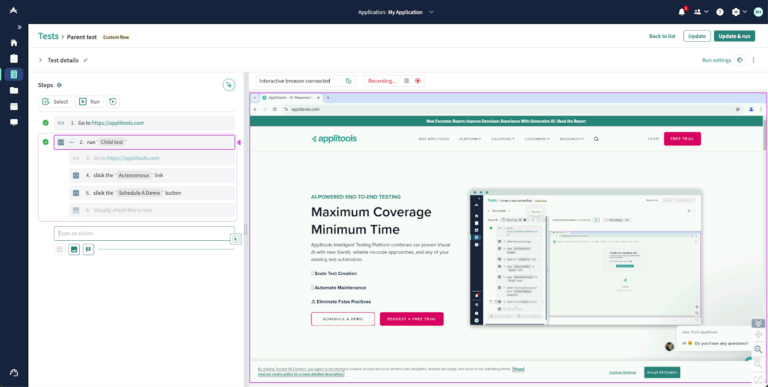
Here’s a breakdown of how it works:
Applitools Autonomous allows for different types of testing, all powered by its Visual AI:
Applitools Autonomous has some strong features that make it worth looking into if you’re trying to streamline your testing process. Here’s my take on the key benefits:
One thing I found impressive is how Applitools generates test cases automatically by crawling your site’s sitemap. It saves a lot of manual work, which can really make a difference when you’re managing multiple test scenarios. The fact that you can describe workflows in plain English is a nice touch, making it easier for non-technical folks to get involved.
The speed of test creation is something that stood out to me. Applitools Autonomous claims to generate tests up to 10 times faster, and in practice, it does seem significantly quicker than traditional methods. The ability to instantly validate thousands of elements and group similar errors together really helps to keep things moving efficiently.
Visual AI is one of the more compelling features. It does a great job of catching both visual and functional issues across different devices and browsers. This kind of coverage is essential if you’re dealing with a variety of platforms and need consistent performance and appearance across all of them.
I also like how you can schedule tests or integrate them into a CI/CD pipeline. This means you can catch bugs early on, which is always a plus. Dealing with issues earlier in the process tends to save time and money down the line, and the proactive nature of this feature is a big win.
By scanning the root domain, Applitools builds out Visual AI scans for each page. This feature is really useful for getting broader test coverage without much manual effort, something I think teams dealing with large-scale applications will appreciate.
The Natural Language Processing (NLP) test builder is another feature that caught my eye. It allows anyone on the team to create tests by describing steps in plain English, which makes the tool accessible to non-technical members. It definitely lowers the barrier to collaboration, which is always a plus.
Running tests at scale can be a pain, but Applitools Autonomous handles this well with its DOM replication technology. It cuts down on test execution time, which makes it easier to test across multiple browsers and devices efficiently.
One of the more practical benefits is automated test maintenance. As your UI changes, the tests update themselves, which minimizes the need for manual updates. This reduces the ongoing workload and keeps your tests relevant without constant tweaking.
Lastly, the dashboard is quite intuitive. It consolidates all your test results and provides a clear breakdown, making it easier to analyze outcomes and resolve issues quickly. The actionable insights offered by Applitools help speed up decision-making and improve overall application quality.
Applitools Autonomous is designed to enhance the testing process across a wide variety of applications, making it an ideal choice for different sectors and use cases. Here are some of the types of applications that are particularly well-suited for testing with Applitools Autonomous:
In a rapidly evolving tech landscape, the need for high-quality software has become paramount. As traditional testing methods struggle to keep pace with the increasing complexity of applications, AI-driven testing solutions like Applitools Autonomous emerge as game-changers. This platform not only streamlines the testing process through automation but also enhances the quality of software by leveraging advanced AI techniques.
Senior QA Lead Manager with over 15 years of experience in QA engineering and automation. Kailash holds certifications including PMI-ACP®, ITIL®, PRINCE2 Practitioner®, ISTQB, and AWS (CFL).
As an active speaker and workshop conductor, he shares his expertise through blogs on platforms like Medium, Dzone, LambdaTest, Talent500, The Test Tribe, and his personal site https://qaautomationlabs.com/